
24 February 2026
The KVG-Schnittstelle is the standardized fund reporting interface used by asset managers and KVGs to provide detailed portfolio and risk data to German savings banks in the context of Depot A business – i.e. proprietary investments made by savings banks on their own balance sheets. The purpose of the KVG-Schnittstelle is to enable savings banks to fulfil regulatory requirements and to support internal risk management based on data that is consistent, validated and subject to official audit.
Adoption of the KVG-Schnittstelle has steadily increased over time. Today, around 100 KVGs are connected to the interface, making it an established reporting standard within the savings bank environment.
The widespread adoption of the KVG-Schnittstelle also has strategic implications. For asset managers seeking to enter the Depot A business, the interface represents a significant technical entry hurdle. It is commonly regarded as one of the most complex regulatory client reporting formats in the German market.
The complexity arises from multiple dimensions. Structurally, depending on the instrument category, around 150 attributes must be delivered and validated against more than 100 quality rules. Operationally, several stakeholders are involved: data is processed and validated via financial.com, CRR figures require auditor attestation, and data flows to and from WM Daten must be maintained. In addition, KVG reports must be aligned with related regulatory outputs such as CRR reporting to WM Daten and GroMiKV reporting to savings banks, requiring strict consistency across reports.
The KVG-Schnittstelle is not merely complex in structure and governance; it has evolved into a continuously changing reporting framework. In recent years, an additional layer of complexity has emerged through increasingly frequent version updates. These changes often require implementation adjustments, renewed testing, and coordination across all involved stakeholders — adding further operational burden for asset managers active in the savings bank market.
From implementation project to ongoing maintenance
Since 2017, the KVG-Schnittstelle has undergone more than 60 version updates — on average, a revision every two months.
The chart below illustrates the evolution of the KVG-Schnittstelle from 2017 to 2026, highlighting major version milestones and their key changes.
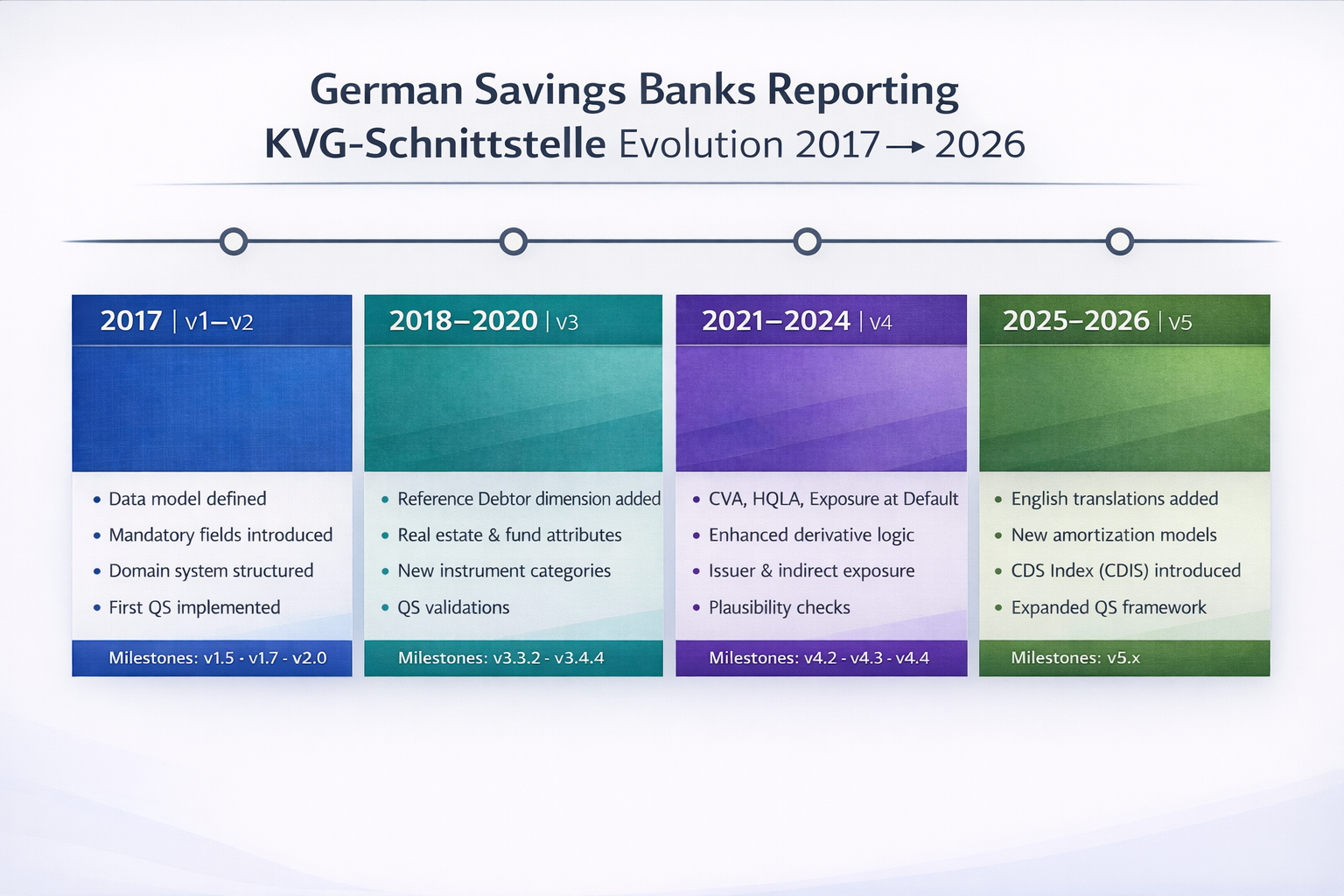
The version changes first focused on establishing the basic data model defining fields, dimensions, instrument categories, and initial validation logic. Over time, additional regulatory depth was added, including more granular exposure logic and fields related to topics such as CVA and liquidity classification. The latest major version updates include Credit Default Index Swaps and loans with specific redemption structures particularly relevant for real estate managers holding such exposures. These additions typically require the collection of further data points from asset managers — information that is often not readily available in existing reporting or portfolio systems and therefore requires structured data sourcing processes and close coordination between portfolio management, fund accounting and reporting teams.
Our perspective
At SolvencyAnalytics, we continuously monitor developments of the KVG-Schnittstelle and adapt our implementation to comply with the latest versions. Where required, we adjust or expand data feeds and coordinate with relevant stakeholders to ensure reporting remains aligned with current technical and regulatory specifications.
If you are considering entering the German Depot A savings bank market or are looking for a solution that keeps pace with ongoing KVG-Schnittstelle version changes, please get in touch with us.