
24 March 2026
Joint Analysis: Unlocking Securitisation under Solvency II
Authors: Tobias Ultsch (Union Investment) &
Dr. Daniel Niedermayer (SolvencyAnalytics)
With trillions in assets under management, the insurance sector remains an important institutional investor.
However, securitisations currently account for less than 1% of insurers’ investment portfolios.
Recognizing this untapped potential, the European Commission has revised the Solvency II framework – specifically through Delegated Regulation (EU) 2026/269 to significantly reduce capital requirements and increase the attractiveness of this asset class. The revised rules will enter into force on 30 January 2027.
Based on our joint analysis at Union Investment and SolvencyAnalytics, here is a summary of the key regulatory changes and what they mean for portfolio construction.




Key Regulatory Relief Measures
The Solvency II review introduces a number of targeted measures within the standard model’s market risk module:
- Reduction in Spread Risk: The risk factors in the Spread Risk sub-module for securitisation investments are being significantly reduced.
- Alignment with Other Asset Classes: For STS (Simple Transparent Standardised) securitisations, the regulatory treatment of senior tranches is aligned with the treatment of covered bonds. Capital requirements for non-STS securitisations (such as CLOs and CMBS) will be better aligned with banking regulations.
- Elimination of Double Ratings: The requirement to conduct a double credit assessment has been removed for simple, transparent and standardised (STS) securitisation positions.
- Adjusted Correlation Matrix: The correlation factor between spread and interest rate risk in a scenario of falling interest rates will be reduced from 0.5 to 0.25.
Strategic Portfolio Implications
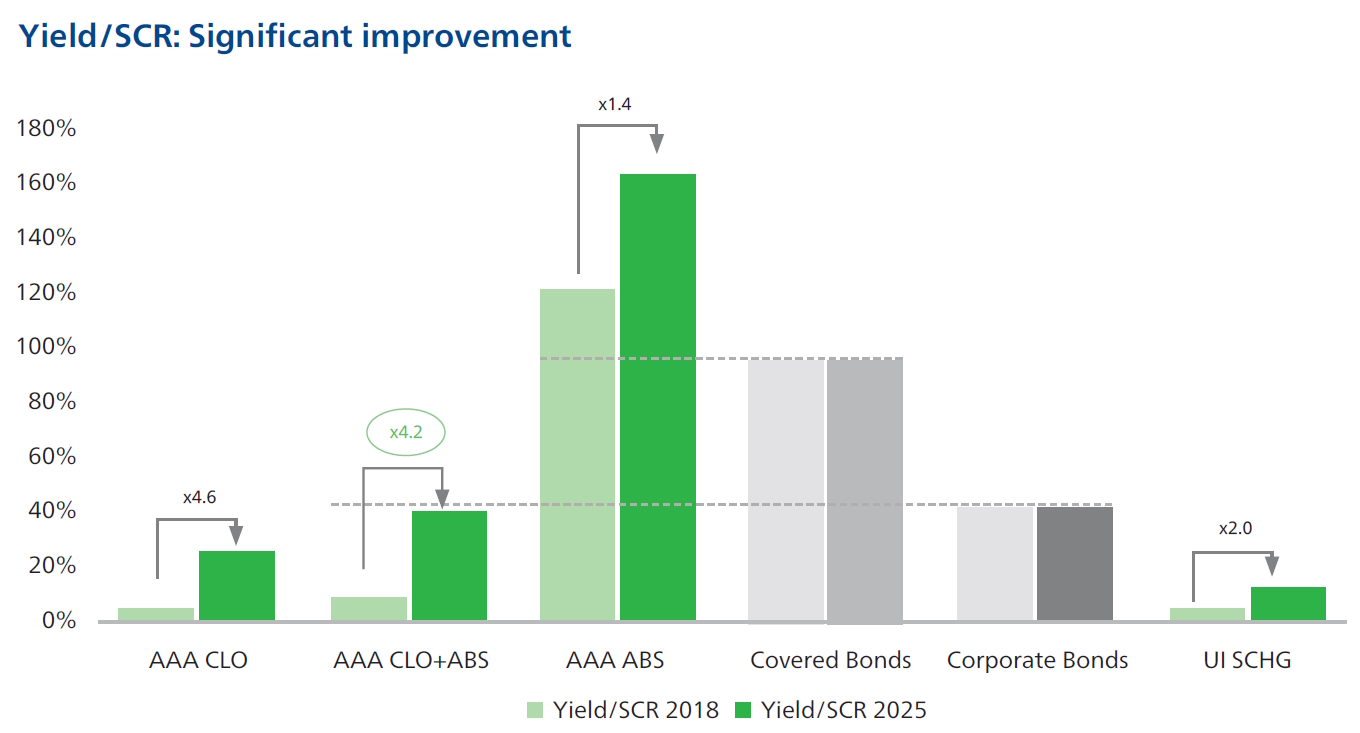
These regulatory adjustments drastically improve the yield-to-Solvency Capital Requirement (Yield/SCR) ratio for securitisations.
- High-Quality Non-STS Benefits: Portfolios with a high proportion of non-STS positions that are senior and have high credit quality (e.g., AAA CLOs) benefit disproportionately, seeing the largest absolute Spread SCR reduction.
- The STS Advantage: Senior STS positions (like ABS and RMBS) enjoy particular regulatory advantages in the senior segment. In terms of the yield/SCR ratio, senior STS positions can now outperform covered bonds.
- The Optimal Combination: Finding the right mix of these sub-portfolios can be highly beneficial from both a regulatory and a risk/return perspective. A combination of STS senior and AAA CLO securitisations delivers a yield/SCR ratio comparable to corporate bonds. Depending on the targeted yield/SCR profile, these exposures can be combined to improve capital efficiency at the portfolio level while maintaining return expectations.
Aligning Investment Strategy with Regulatory Reporting
To truly capture the effects of the improved regulatory treatment of securitisation, your SCR calculations and the optimization of your investments should be aligned with your regulatory reporting (such as TPT reports).
Currently, the FinDatEx TPT template is not expected to be changed. However, as an active member of the working group, SolvencyAnalytics is closely monitoring the developments. We are ensuring our clients remain perfectly positioned to reflect these capital relief measures seamlessly in their reporting workflows.
Get in touch with us if you want to know more about the treatment of securitisation portfolios under Solvency II and the relevance for your Solvency II regulatory reporting.